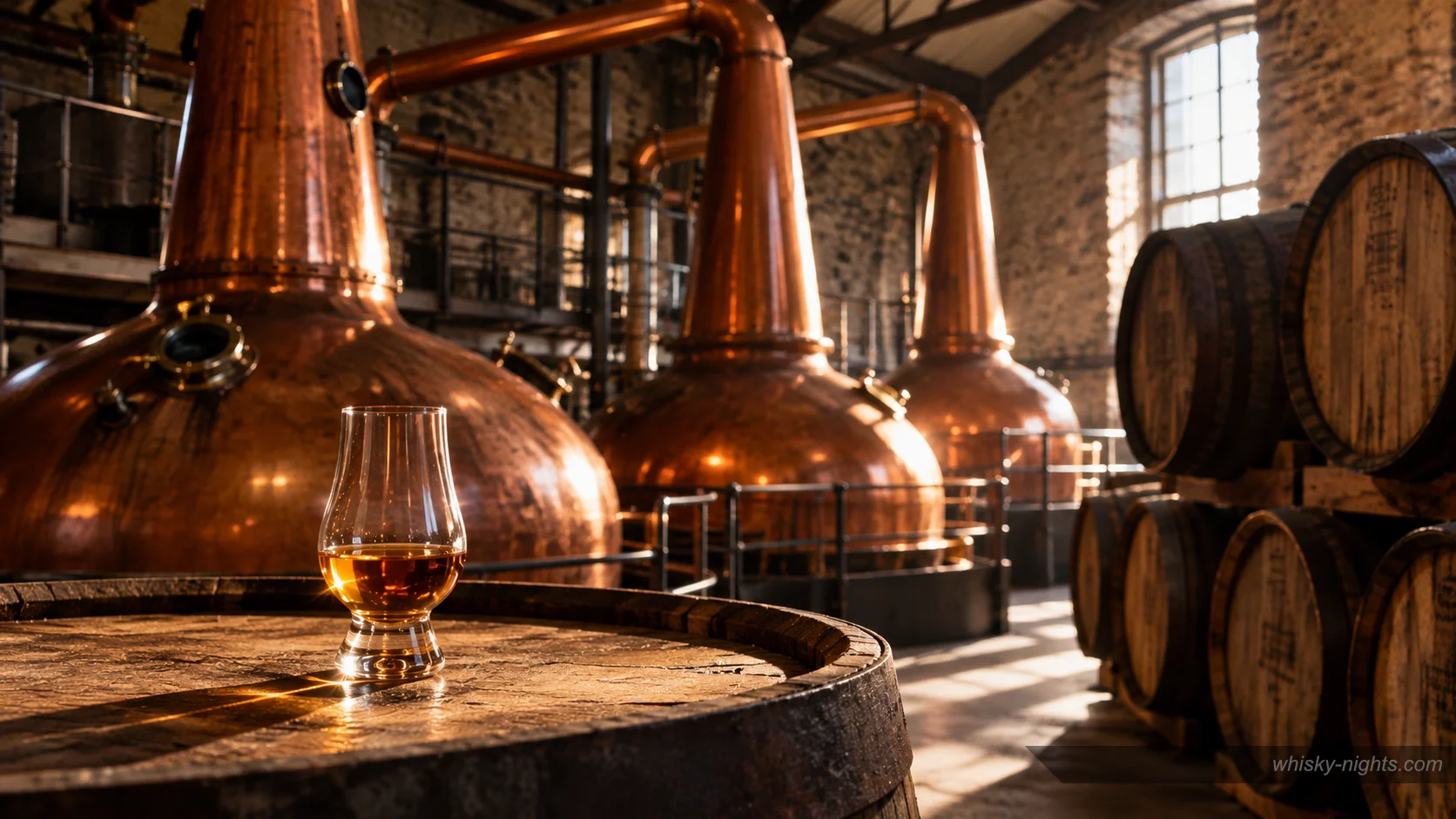
Scotch whisky is one of the world’s most recognisable spirits, known for its remarkable variety of flavours, from light, fruity and floral notes to rich dried fruit, spice and intense peat smoke. Made in Scotland, it has a history stretching back centuries and a production process governed by strict legal requirements.
Yet choosing a bottle can be confusing. Terms such as single malt, blended Scotch, Speyside and peated describe different aspects of whisky, and understanding them can make exploring Scotch much more rewarding.
This guide explains what Scotch whisky is, how its regions and categories differ, what shapes its flavour, and how to choose a bottle that suits your taste.
1. What Is Scotch Whisky?
Scotch whisky is whisky made in Scotland in accordance with the legal requirements set out in the Scotch Whisky Regulations 2009. Its identity depends not only on where it is produced, but also on how it is distilled and matured.
Under UK law, Scotch whisky must meet several key requirements:
- It must be distilled at a distillery in Scotland from water and cereals, including malted barley.
- It must be distilled to retain the aroma and flavour of its raw materials and production method.
- It must be matured in Scotland in oak casks with a capacity of no more than 700 litres.
- It must mature for at least three years.
- It must be matured in an excise warehouse or another permitted place.
- It must have a minimum alcoholic strength of 40% alcohol by volume (ABV) when bottled.
- Only water and plain caramel colouring may be added, subject to the regulations.
These requirements help protect the identity and quality of Scotch whisky. They also mean that a whisky cannot be called Scotch simply because it resembles a Scottish style or uses Scottish ingredients.
A brief history of Scotch whisky
One of the earliest documented references to whisky distilling in Scotland appears in the Exchequer Rolls of 1494. The record refers to malt supplied to Friar John Cor to produce aqua vitae, Latin for “water of life”.
Over the following centuries, whisky production expanded, although taxation and restrictions encouraged illicit distilling in some areas. A major turning point came with the Excise Act of 1823, which established a more practical system for licensed production and helped lay the foundations for the modern Scotch whisky industry.
The introduction of continuous distillation technology in the nineteenth century also transformed production. It enabled grain whisky to be made more efficiently and helped the development of blended Scotch whisky, which became a major part of the category’s international success.
Today, Scotch whisky ranges from accessible everyday blends to distinctive single malts made in individual distilleries. Its variety reflects differences in ingredients, distillation, maturation and blending, rather than simply the age of the spirit.
How does Scotch compare with other whiskies?
Whisky is produced in many countries, each with its own traditions and, in some cases, legal definitions.
Scotch whisky must be produced and matured in Scotland under the relevant regulations. It can be made as malt whisky, grain whisky or a blend of the two.
Irish whiskey is produced on the island of Ireland and has its own production traditions and legal requirements. It is often associated with a smooth, approachable style, although Irish whiskey can be diverse.
American whiskey, including bourbon and rye whiskey, follows different production rules. Bourbon, for example, must be made from a grain mixture containing at least 51% corn and matured in new, charred oak containers.
Japanese whisky has its own history and production styles, drawing on influences from Scotch while developing distinct approaches of its own. Japan also has industry standards defining Japanese whisky, so the term should not be treated as interchangeable with Scotch.
No country’s whisky is inherently better than another. The most suitable style depends on the flavours and character you enjoy.
2. The Five Scotch Whisky Regions
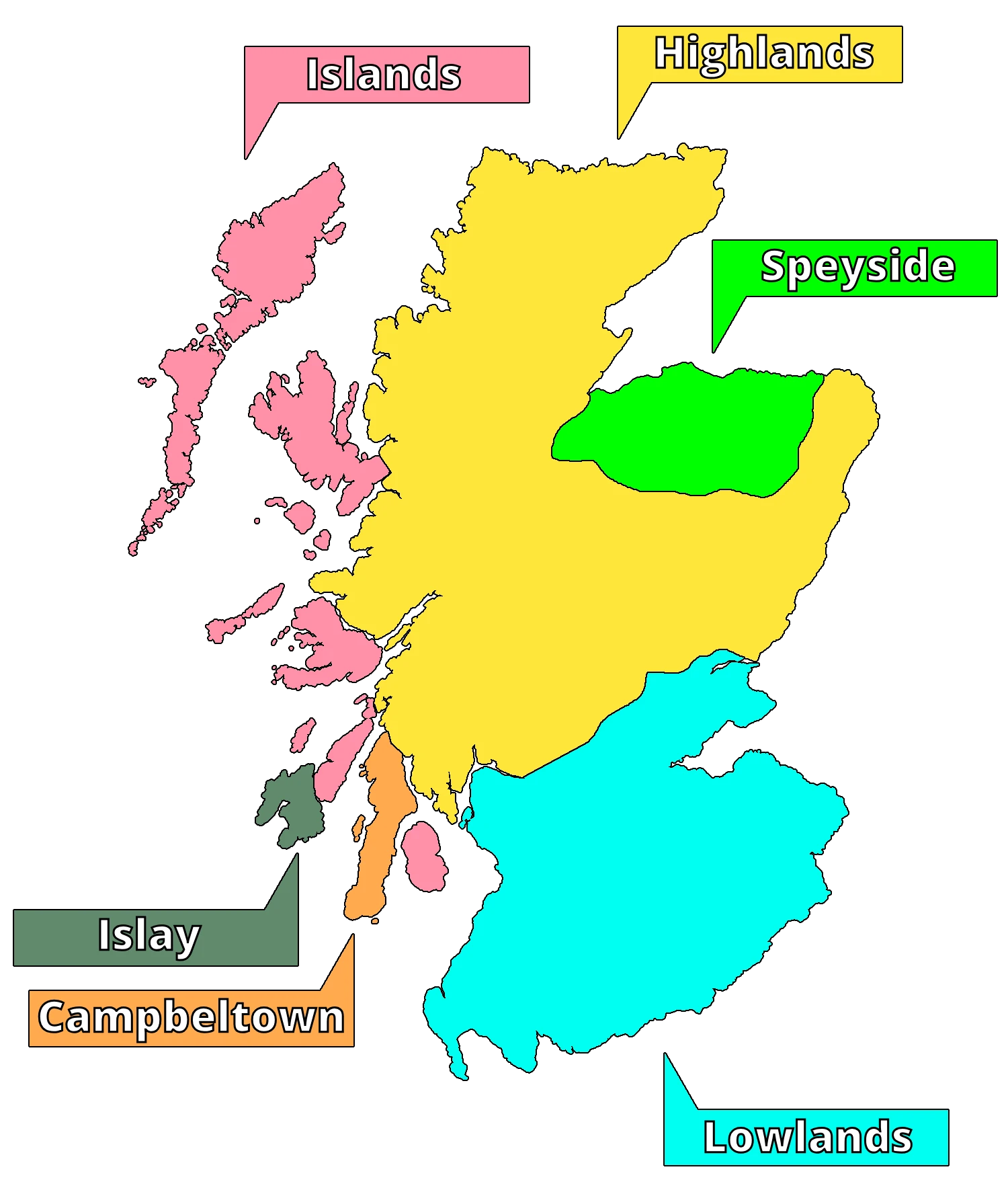
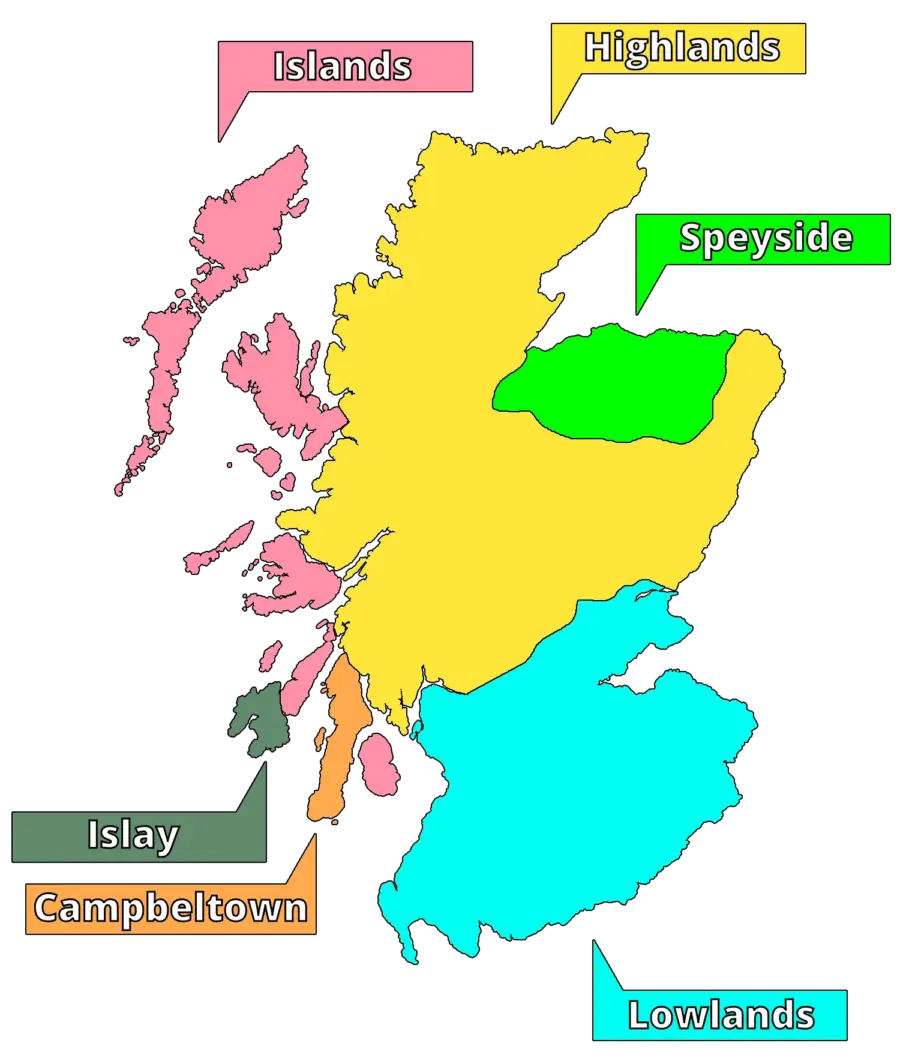
Scotch whisky is commonly discussed in terms of five regions: Highland, Speyside, Lowland, Campbeltown and Islay. These geographical distinctions are useful when exploring the category, but they should not be treated as strict flavour rules. Distilleries within the same region can produce very different whiskies.
Highland
The Highland region covers a large and varied part of mainland Scotland. Its whiskies range from light and floral to full-bodied, spicy, fruity or smoky.
Some Highland malts feature notes of orchard fruit, honey and vanilla, while others offer richer flavours of dried fruit, malt, spice or coastal character. Because the region is so large, it is difficult to describe a single Highland flavour profile.
A good choice if: you want to explore a broad range of styles and are happy to compare different distilleries.
Speyside
Located within the wider Highland geographical area, Speyside is traditionally recognised as a distinct Scotch whisky region. It is home to a high concentration of distilleries and is often associated with fruit-forward, approachable single malts.
Common tasting notes include apple, pear, honey, vanilla and gentle spice. Some Speyside whiskies are matured in sherry casks, which can contribute flavours of raisins, dates, dried fruit, nuts and richer spice.
However, Speyside is not exclusively sweet or light. Its distilleries produce a wide range of styles, including whiskies with pronounced smoke or more robust character.
A good choice if: you enjoy fruity, rounded flavours or want a starting point for exploring single malt Scotch.
Lowland
Produced in southern Scotland, Lowland whisky is often associated with lighter, gentler styles. Depending on the distillery, you may find notes of fresh fruit, citrus, grass, flowers or cereal.
Some Lowland whiskies are particularly delicate, while others have more body and complexity. The region also includes a growing range of distilleries experimenting with different approaches to production and maturation.
A good choice if: you prefer lighter flavours or want a whisky that feels less intense than a heavily peated malt.
Campbeltown
Campbeltown is a small whisky-producing area on Scotland’s west coast with a distinctive history. Its whiskies can be robust, complex and sometimes slightly maritime in character.
Depending on the distillery and expression, flavours may include fruit, vanilla, toffee, spice, oiliness and smoke. Some have a noticeable coastal character, although this is not universal.
Campbeltown’s relatively small number of producers makes it an interesting region to explore once you want to move beyond the best-known styles.
A good choice if: you enjoy characterful whiskies with a combination of richness, fruit and potentially savoury or smoky notes.
Islay
Islay is an island off Scotland’s west coast and is especially famous for heavily peated Scotch whisky. Peat smoke can create aromas reminiscent of a bonfire, wood smoke, earth or medicinal notes.
Some Islay whiskies combine intense smoke with seaweed-like, savoury or coastal impressions, while others are lighter, sweeter or more restrained. Not every Islay whisky is heavily peated, and the region should not be reduced to smoke alone.
A good choice if: you enjoy bold flavours and want to explore smoky, earthy or medicinal characteristics.
What about the Islands?
You may also see the term Island whisky used for whiskies produced on Scottish islands other than Islay, including places such as Orkney, Skye and Mull.
The Islands are commonly discussed as a group, but they are not a separate one of the five traditional Scotch whisky regions in the same way as Islay or Speyside. In the traditional regional classification, the other Scottish islands fall within the Highland region.
Island whiskies are diverse. Depending on the distillery, they may show smoke, spice, fruit, maritime notes or a combination of these characteristics.
The key point is that regional descriptions are a starting point, not a guarantee of flavour. The distillery, production methods and maturation often tell you more about an individual bottle.
3. The Five Categories of Scotch Whisky
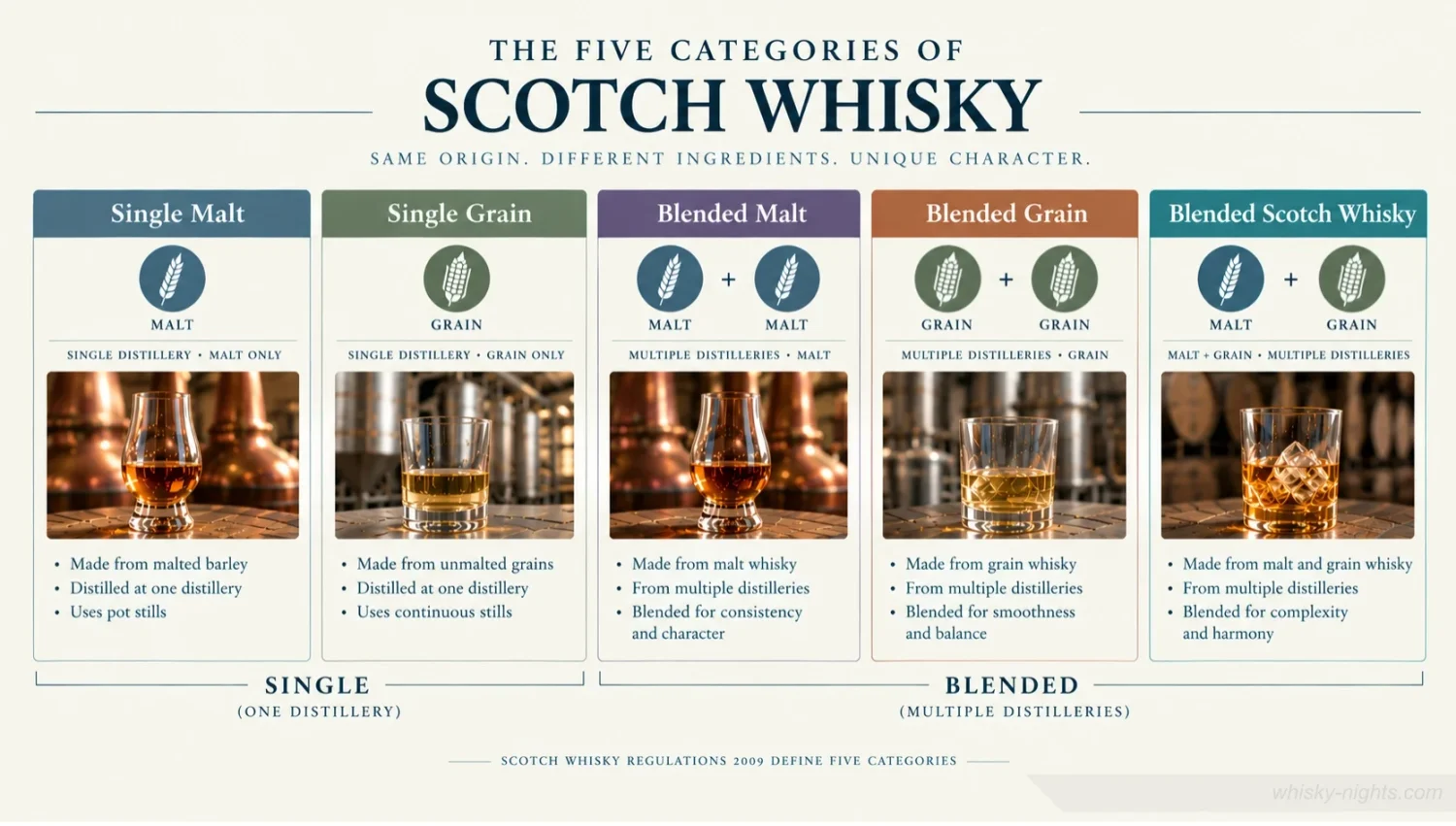
The words on a Scotch whisky label can tell you how it was made and whether it combines whisky from one or several distilleries. UK regulations recognise five categories.
Single Malt Scotch Whisky
Single malt Scotch whisky is made at one distillery using water and malted barley, with no other cereals, and is distilled in copper pot stills. It must be bottled in Scotland.
The word single refers to the distillery, not to a single cask or a single batch. A single malt may combine whisky from many casks, provided the whisky comes from the same distillery.
Single malts are often valued for the distinctive character of the distillery, although their flavour can vary considerably according to cask selection, age and production methods.
Single Grain Scotch Whisky
Single grain Scotch whisky is made at one distillery but does not meet the legal definition of single malt. It may use malted barley alongside other whole grains, such as wheat or corn, and is often produced using a continuous still.
Grain whisky can be light, smooth and subtle, with flavours such as vanilla, cereal, caramel or gentle spice. It is an important component of many blended Scotch whiskies, although single grain bottlings are also available.
The word grain does not mean that the whisky is necessarily made from only one type of grain.
Blended Scotch Whisky
Blended Scotch whisky combines one or more single malt Scotch whiskies with one or more single grain Scotch whiskies.
Blending allows producers to balance different flavours and create a consistent house style. Depending on the blend, the result may be light and approachable, rich and fruity, spicy or smoky.
Blended Scotch is often a practical starting point for newcomers because there are many accessible options at different price points. It is also enjoyed by experienced whisky drinkers, particularly in cocktails and mixed drinks.
Blended Malt Scotch Whisky
Blended malt Scotch whisky combines two or more single malt Scotch whiskies from different distilleries. It contains no grain whisky.
By combining malts with different characteristics, producers can create a whisky with a distinctive flavour profile that does not belong to just one distillery.
This category can be especially interesting for drinkers who enjoy the character of malt whisky but want to explore how different distillery styles work together.
Blended Grain Scotch Whisky
Blended grain Scotch whisky combines single grain Scotch whiskies from more than one distillery.
These whiskies are less commonly encountered than blended Scotch or single malt, but they can offer a different perspective on grain whisky, with the possibility of a light, mellow and nuanced profile.
Which category should you choose?
There is no universal ranking from best to worst. The category tells you how the whisky was produced, not how good it tastes.
If you want to explore the character of a particular distillery, start with a single malt. If you prefer balance and consistency, a blended Scotch may suit you. Blended malts are worth trying if you enjoy malt whisky and want to explore combinations of distillery styles.
4. What Shapes the Flavour of Scotch Whisky?
A whisky’s flavour is influenced by several stages of production. Regional reputation can be useful, but understanding these factors gives you a more reliable way to choose a bottle.
Peat and smoke
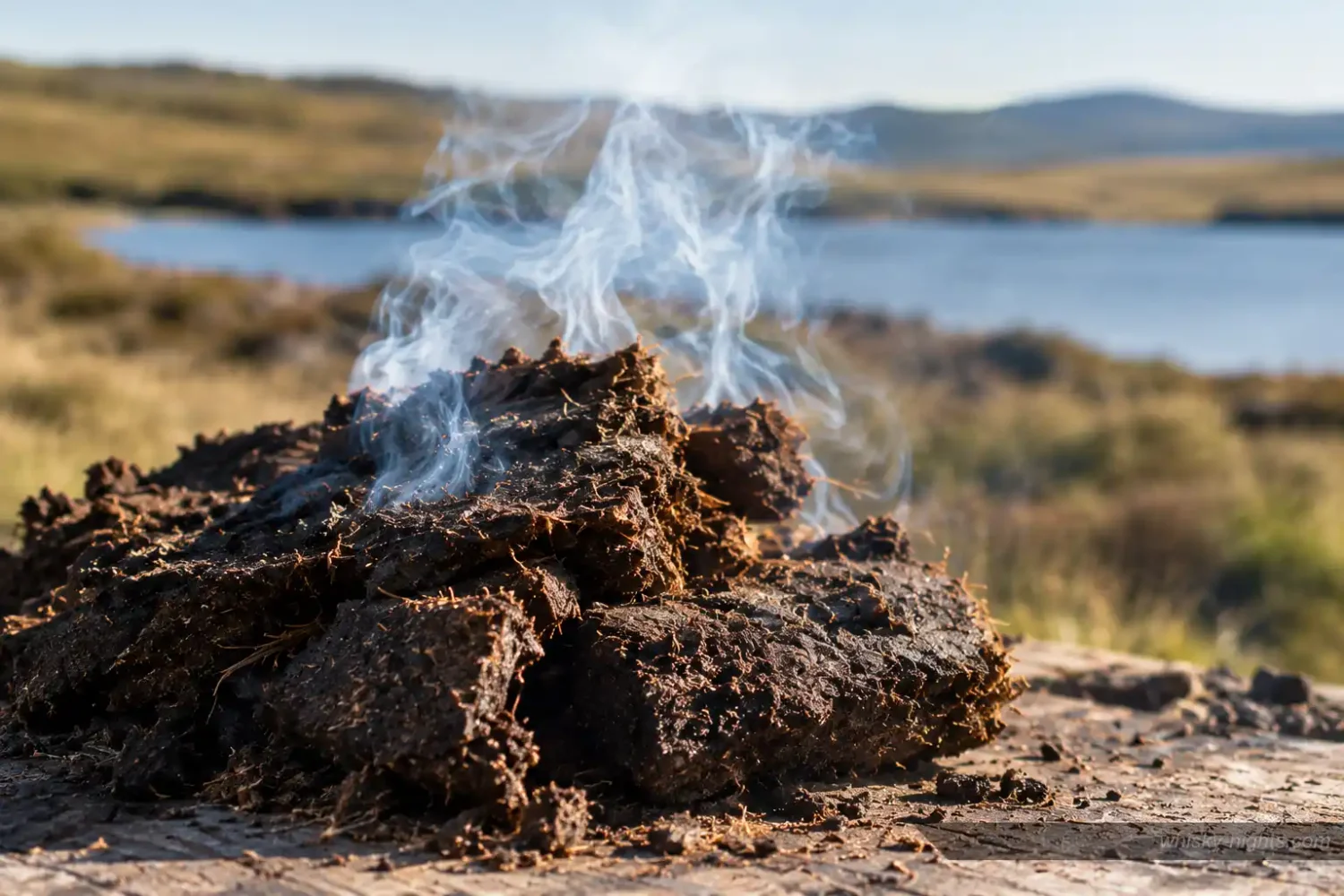
Peat is partially decomposed plant material that has accumulated in waterlogged conditions. In whisky production, peat can be burned to dry malted barley, exposing it to smoke that contributes distinctive aromas and flavours.
The resulting whisky may evoke a campfire, earthy soil, smoked meat, ash or medicinal notes. The intensity varies according to how the barley is dried and how the whisky is produced and matured.
Not all Scotch whisky is peated. Some producers use little or no peat, creating whiskies that focus instead on fruit, cereal, floral notes or cask-derived flavours.
If you are new to smoky whisky, consider starting with a lightly peated expression before moving to a heavily peated Islay malt. If you already enjoy smoke, comparing several peated whiskies is a useful way to discover how different distilleries interpret it.
Cask maturation
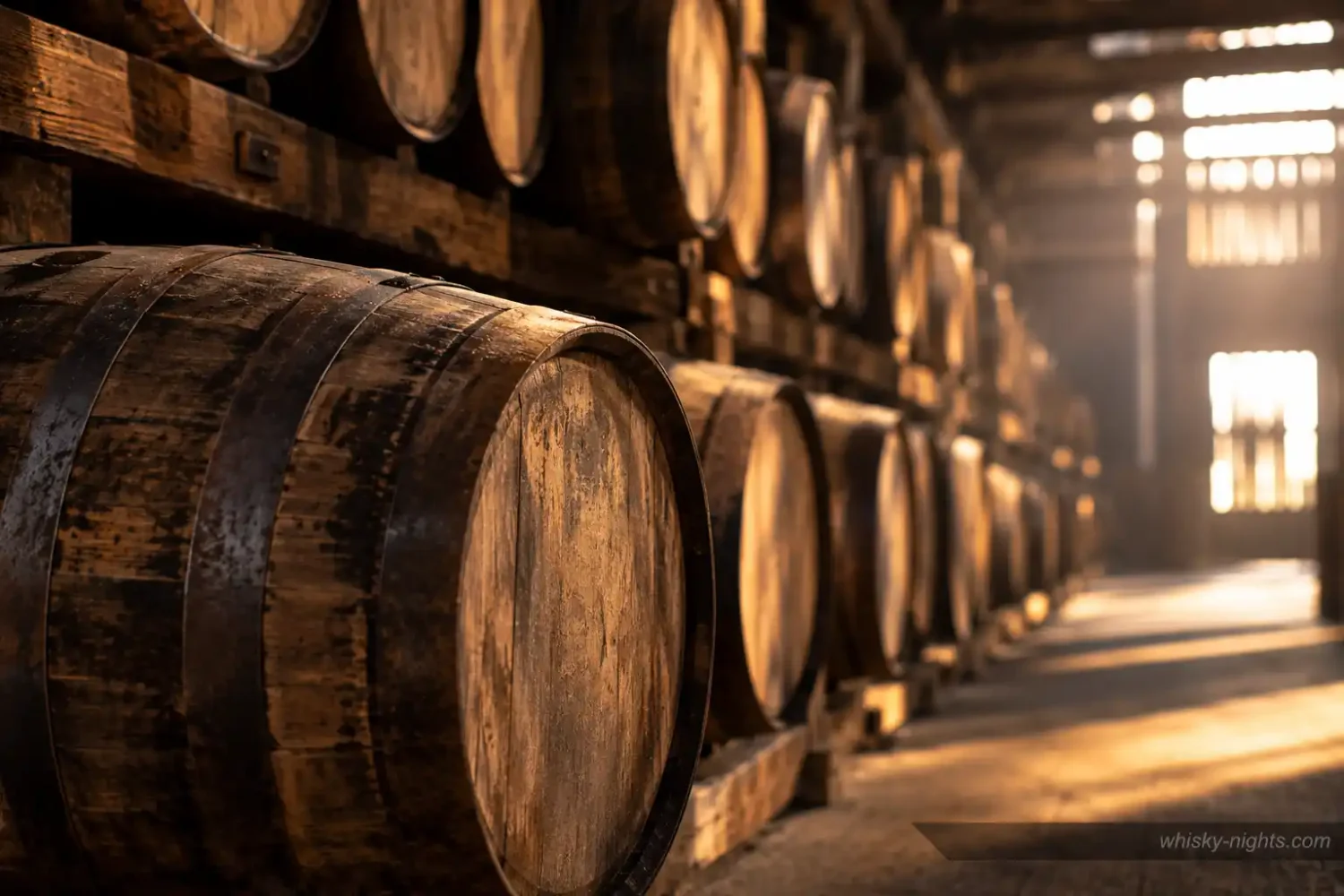
Maturation in oak casks is one of the most important influences on Scotch whisky. During this period, the spirit develops and changes through interaction with the wood and the surrounding environment.
Many casks used for Scotch whisky have previously held other drinks. Two common examples are ex-bourbon casks and ex-sherry casks.
Ex-bourbon casks often contribute flavours associated with vanilla, honey, coconut, caramel and sweet spice. Their influence depends on the cask’s history, the condition of the wood and the whisky itself.
Sherry casks may contribute notes of dried fruit, raisins, dates, nuts, chocolate and richer spice. The result varies according to the type of sherry previously held, the cask and the maturation process.
Some whiskies are matured in one type of cask and then transferred to another for a finishing period. This can add another layer of flavour, although the effect is not always stronger or better.
Cask type is a useful guide, but it should not be read as a precise tasting promise. The same type of cask can produce different results in different whiskies.
Age statements
A number on a Scotch whisky label, such as 10, 12 or 18 years, refers to the minimum age of the whisky in the bottle. In a whisky made from several casks, every component must have spent at least that long maturing.
Scotch whisky must mature for at least three years to qualify as Scotch. Many bottlings are aged for considerably longer.
Older whisky can develop greater complexity and deeper cask influence, but age alone does not determine quality. A younger whisky can be vibrant and expressive, while an older one may be more subtle or heavily influenced by wood.
If a bottle has no age statement, that does not automatically mean it is young or poor quality. It means the label does not declare a specific age. The producer may have selected whiskies of different ages to achieve a particular style.
Other influences
Flavour also depends on the barley, fermentation, distillation equipment, the shape and operation of stills, and the choices made by the distillery’s production team.
Water is important to production, but claims that a particular water source alone explains a whisky’s character should be treated cautiously. The final flavour is the result of many interacting factors rather than a single ingredient or location.
5. How to Choose a Scotch Whisky
With so many bottles available, it helps to start with the flavours you already enjoy rather than trying to identify the “best” Scotch.
If you prefer light, fresh flavours
Look for descriptions such as light, fresh, floral, citrus or orchard fruit. Some Lowland whiskies and lighter Highland or Speyside malts may be a good place to start.
These descriptions are not exclusive to any region, so read the tasting notes on the bottle or retailer’s website.
If you enjoy fruit, honey and vanilla
Try a Speyside or Highland single malt described as fruity, honeyed or smooth. If you like richer flavours, look for references to sherry casks, dried fruit or baking spice.
A whisky matured in ex-bourbon casks may be a useful choice if you enjoy vanilla and caramel notes.
If you prefer rich, dark flavours
Look for tasting notes such as dried fruit, raisins, dates, nuts, chocolate or spice. Sherry-cask-matured whiskies are often associated with these characteristics, although the actual flavour depends on the whisky and cask.
If you enjoy smoke
Look for the word peated and check the producer’s tasting notes for smoke intensity. Islay is a natural region to explore, but peated whiskies are produced elsewhere in Scotland too.
Smoke can range from a subtle background note to an intense, medicinal or ash-like character. If possible, sample before buying a full bottle.
If you are new to Scotch whisky
A versatile blended Scotch or a lighter, unpeated single malt can be a good starting point. You do not need to begin with an expensive bottle or a heavily peated whisky to appreciate Scotch.
Try two or three different styles side by side, if possible. Comparing them can make it easier to identify whether you prefer fruit, sweetness, spice, smoke or a lighter profile.
Consider your budget and how you plan to drink it
Price can reflect age, rarity, production costs, brand positioning and demand, but it does not guarantee that a whisky will suit your taste.
For drinking neat, you may want to spend more time exploring a bottle’s aroma and flavour. For highballs or cocktails, a well-balanced, reasonably priced blend can work very well. The best choice is the one that suits both your preferences and your intended use.
6. How to Drink Scotch Whisky

There is no single correct way to enjoy Scotch whisky. Different serving methods can highlight different aspects of the same bottle, from its aroma and flavour to its texture and finish. Try a few styles to discover what suits your taste.
Neat
Pour a small measure into a whisky glass, ideally a tulip-shaped glass that helps concentrate the aromas. Smell it gently from a short distance, then take a small sip and let the whisky move across your palate before swallowing.
Take your time. As the whisky sits in the glass, its aromas may develop, and you may notice different flavours on the finish.
On the Rocks
Serving Scotch over ice chills the whisky and gradually dilutes it as the ice melts. The lower temperature can soften the sensation of alcohol, although it may also make some aromas less pronounced.
Large ice cubes tend to melt more slowly than small ones, giving you greater control over dilution. This is a good option if you prefer a cooler, refreshing drink.
With Water
Adding a few drops of still water can change how a Scotch whisky’s aromas and flavours are perceived. It may help bring certain characteristics into focus and soften the sensation of alcohol. Add the water gradually, tasting as you go, since the ideal amount varies from one whisky to another.
For a more diluted tasting experience, you can also try twice-up, which combines equal parts whisky and room-temperature water, served without ice. In Japan, whisky is also commonly enjoyed as mizuwari, a longer drink made with whisky, still water and ice.
As a Highball
A highball combines Scotch whisky with soda water and ice, usually served in a tall glass. The carbonation creates a crisp, refreshing drink, while the dilution makes the whisky approachable without necessarily hiding its character.
Highballs are enjoyed around the world and are particularly popular in Japan. Lighter blends and whiskies with fresh, fruity flavours can work especially well, although more robust Scotch whiskies can also make distinctive highballs.
In a Cocktail
Scotch whisky can also be enjoyed in classic cocktails, where other ingredients complement or contrast with its character.
Well-known examples include the Rob Roy, a rich, whisky-forward cocktail; the Rusty Nail, known for its sweet honey and herbal notes; and the Blood and Sand, a fruitier cocktail with citrus and cherry flavours. Each offers a different way to experience Scotch beyond drinking it on its own.
Take Your Time and Drink Responsibly
Whisky tasting is about noticing aroma, flavour, texture and finish rather than drinking quickly. Small measures and water between tastings can help you explore different styles at a comfortable pace.
Scotch whisky is an alcoholic drink. Enjoy it responsibly, and never drive after drinking.
Final Thoughts
Scotch whisky offers far more variety than a simple distinction between single malt and blended whisky can suggest. Its five categories explain how it is made, while regions offer a useful introduction to the range of styles found across Scotland.
Peat, cask maturation, age and distillery methods all contribute to a whisky’s character. None of these factors guarantees that a bottle will suit every drinker, and regional descriptions should be treated as guidance rather than rules.
If you are just beginning to explore Scotch, start with the flavours you enjoy, try a few contrasting styles and pay attention to what you notice. Whether you prefer fresh fruit, rich sherry-cask notes, gentle spice or intense smoke, there is a Scotch whisky worth discovering.
Further Reading
Here are more articles from the same category.
About Whisky Nights
Whisky Nights is a Japan-based online liquor store and whisky publication offering clear, reliable information and carefully selected bottles for international customers worldwide.
Learn more about us