
One of the pleasures of whisky is discovering the aromas and flavours that make each expression distinctive. These can range from bright, fruity aromas and gentle grain notes to warming spices and the woody nuances developed during cask maturation.
Tasting whisky may seem to require specialist knowledge or training, but understanding a few basic techniques can help beginners appreciate its character more deeply. The aim is not to identify a predetermined set of aromas or flavours correctly, but to pay attention to what you actually experience.
This guide explains how to assess a whisky’s appearance, aroma, flavour and finish, how adding water can change its character, and how to write your own tasting notes.
1. Getting Started with Whisky Tasting
Preparing to Taste Whisky
You do not need special equipment to taste whisky, but paying attention to your glass and surroundings can make it easier to appreciate its aromas.
A tulip-shaped glass with a narrower opening is a good choice. A Glencairn glass, copita glass or other tulip-shaped tasting glass can help concentrate aromas, although any clean glass can be used.
Your surroundings also matter. Strong smells from perfume or food can make it harder to appreciate a whisky’s aromas. Whenever possible, choose a quiet environment with minimal competing scents and take your time.
A small pour is enough to begin with. Rather than drinking a large amount at once, take time to assess the aroma, sip a little and observe how the flavours develop after swallowing. If the alcohol feels too intense, there is no need to bring your nose too close to the glass or take a large sip.
Tasting is not about using complicated terminology. Start with familiar words such as sweet, fruity or spicy, and build your own vocabulary as you gain experience.
2. Appearance: Colour and Clarity

Begin by observing the whisky in your glass. Its colour may range from pale gold to amber or reddish brown, while its clarity can also vary. Looking at it against a light background can make these differences easier to see.
Cask maturation plays an important role in a whisky’s colour. Compounds extracted from the oak, along with influences from the cask’s previous contents, can affect both its colour and flavour. However, colour alone cannot reliably reveal a whisky’s age or the type of cask used. The oak species, the cask’s previous use and the maturation conditions can all influence the result. Some whiskies may also contain caramel colouring to adjust their appearance.
Treat appearance as an initial point of reference rather than a definitive guide to the whisky’s character. Simple descriptions such as pale gold, reddish amber or clear and bright are useful starting points for your tasting notes.
Rather than drawing conclusions about flavour from colour alone, move on to the aroma.
3. Aroma: How to Nose Whisky

To explore a whisky’s aroma, bring the glass towards your nose gently and smell from a comfortable distance. If the alcohol feels overpowering, move the glass further away. Taking several short sniffs can make it easier to identify individual aromas than inhaling deeply in one go.
You can also gently swirl the glass, but there is no need to do so straight away. First, smell the whisky while it is still, then try swirling it lightly and see whether the aroma changes.
Thinking in terms of broad categories can help you identify different aromas:
- Fruit: Apple, pear, citrus, peach and raisin.
- Grain: Malt, cereal, bread and biscuit.
- Sweet: Vanilla, honey, caramel and chocolate.
- Spice: Cinnamon, clove and black pepper.
- Wood: Oak, dry wood and aromas reminiscent of a cask.
- Smoke: Bonfire, ash and smoked foods.
These are simply examples to help you organise what you smell. You do not need to identify every aroma. Start by finding one or two that stand out to you.
A whisky’s aroma can also change over time. Alcohol may dominate at first, but after allowing the whisky to rest briefly in the glass, you may begin to notice fruit, grain or spice notes that were less apparent initially.
Different people can experience the same whisky differently. One person might detect apple while another notices pear. Neither impression is necessarily wrong. The important thing is to describe what you perceive in your own words.
4. Flavour: What Do You Taste?
Once you have explored the aroma, take a small sip. Rather than analysing every detail immediately, begin by considering your overall impression.
You might notice sweetness, bitterness, acidity, spice or flavours associated with oak. Some whiskies suggest honey or caramel, while others bring to mind the freshness of citrus, the heat of pepper or the character of wood. Each expression has its own combination of characteristics.
A sweet-smelling whisky does not necessarily taste particularly sweet. It helps to distinguish between aromas that suggest vanilla or honey and sweetness perceived on the tongue. Making this distinction can help you describe the flavour more precisely.
Pay attention to the texture as well. Does the whisky feel light and crisp, smooth and rounded, or oily and full-bodied? Mouthfeel is an important part of the overall experience, alongside aroma and flavour.
It is also useful to understand how aroma and flavour work together. When you sip whisky, aromas travel from the mouth towards the nose, contributing to the overall perception of flavour. This is why a whisky can seem different when tasted from how it smells in the glass.
Rather than relying on broad terms such as sweet or spicy, try combining several observations. For example, you might describe a whisky as having apple-like aromas with a hint of black pepper or gentle sweetness alongside a dry, woody character. This makes your tasting notes more specific and useful.
5. Finish: How Long Does the Flavour Last?
The flavours and sensations that remain after swallowing whisky are known as the finish. Paying attention to how they develop after the sip can reveal more about the whisky’s character.
Start by considering how long the flavours last. Some finishes fade quickly, while others linger for a considerable time. However, a long finish does not automatically indicate higher quality. A short, clean finish can be just as appealing, depending on the whisky.
Length is only part of the picture. Consider which flavours remain. Do fruity aromas persist? Does a spicy sensation linger? Do notes of oak or smoke become more noticeable? The impressions left after swallowing may differ from those experienced on the palate.
In your tasting notes, combine the length of the finish with its character. Descriptions such as short and clean, a gentle lingering fruitiness or a long-lasting spicy finish provide a clearer picture than length alone.
6. Alcohol Strength and Adding Water
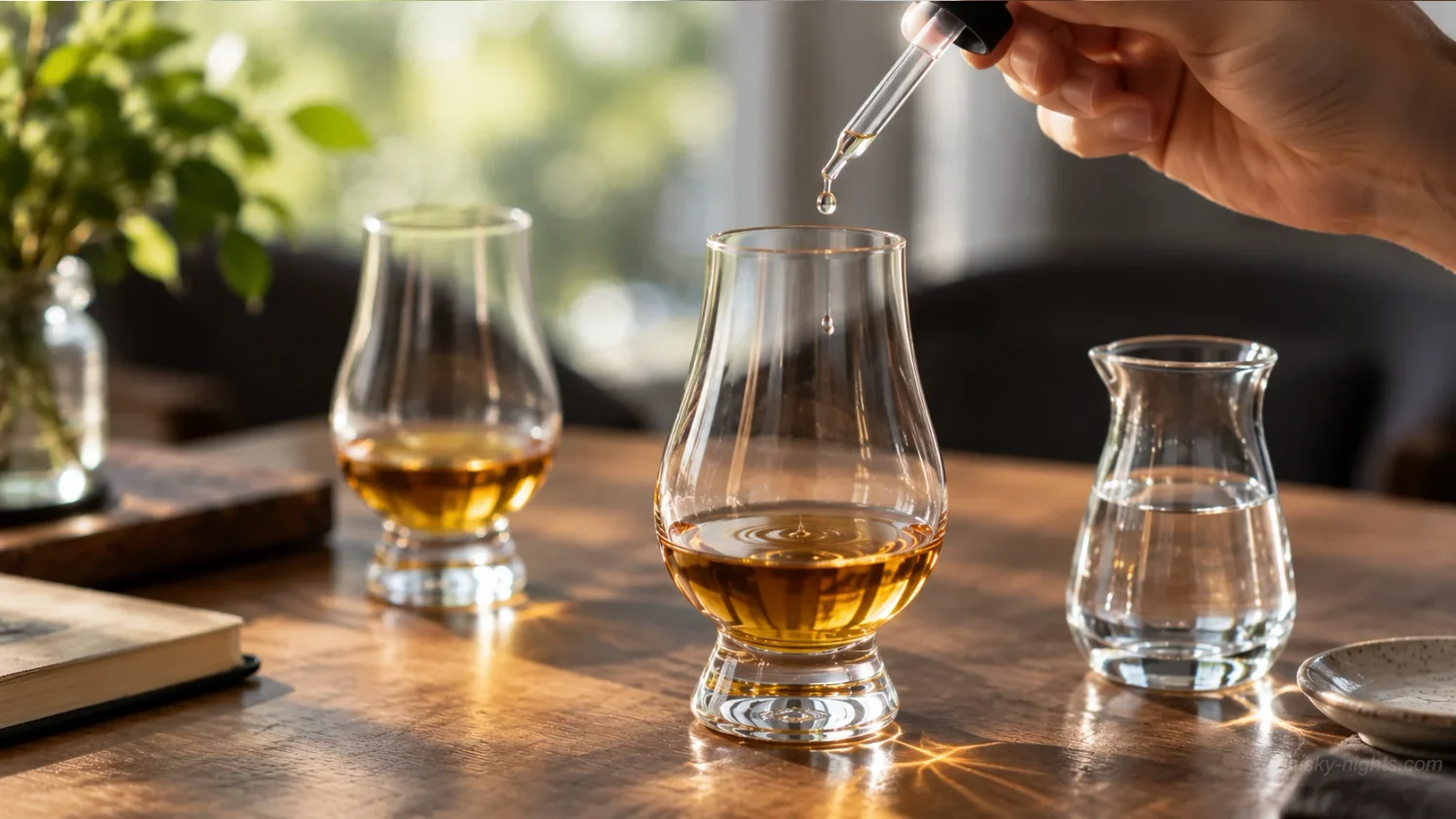
A whisky’s alcohol by volume (ABV) can influence how its aromas and flavours are perceived. Higher-strength whiskies may produce a more pronounced alcohol sensation, which can make some aromas harder to detect. However, a higher ABV does not necessarily make a whisky difficult to enjoy; individual perceptions vary.
One way to explore a whisky further is to add a little water. A few drops may soften the alcohol sensation and make certain aromas or flavours easier to appreciate. However, water can also reduce the intensity of some aromas or alter the balance of flavours. Adding water does not always make a whisky more expressive.
To experiment, first assess the whisky neat, noting its aroma and flavour. Then add a few drops of water, smell it again and take another small sip. Add a little more if needed, comparing the changes at each stage. Introducing water gradually makes it easier to notice how the whisky develops.
Another approach is twice up, which generally involves mixing whisky and water in approximately equal proportions. This can be useful for exploring a whisky’s aromas and flavours at a lower strength, particularly when the alcohol sensation is prominent when tasting it neat.
There is no single correct way to drink whisky. Comparing it neat and with water can reveal different aspects of the same expression and help you find the balance you prefer. If you enjoy it neat, there is no need to add water at all.
7. Writing Your Own Tasting Notes
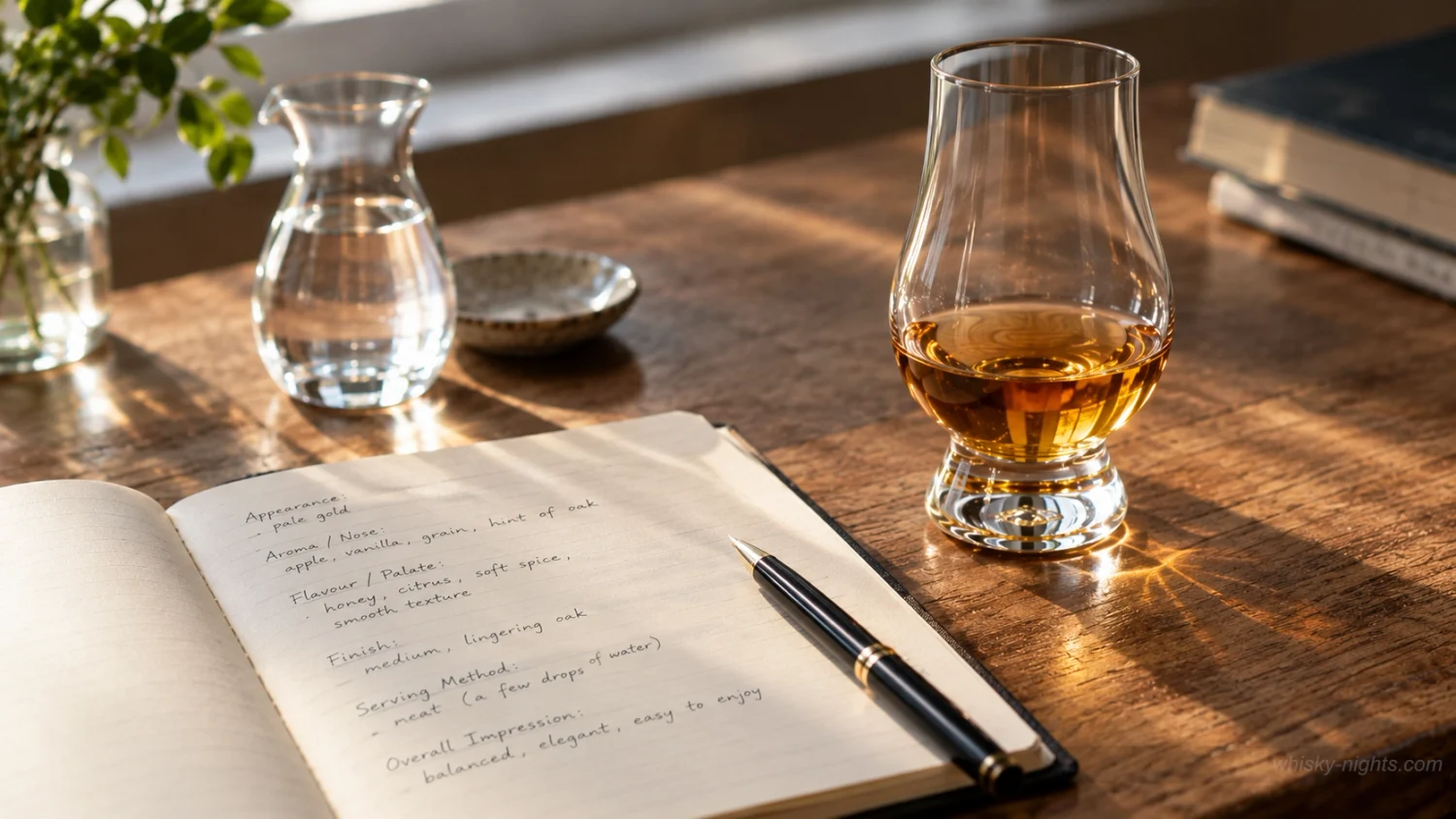
Tasting notes are a way of recording a whisky’s aroma, flavour, finish and other characteristics. Keeping a record makes it easier to compare expressions later and reflect on your own preferences.
You do not need specialist terminology to get started. Instead of writing simply fruity, for example, try a more specific description such as aromas of ripe apple. Similarly, a peppery sensation reminiscent of black pepper communicates more than the general term spicy.
A simple set of headings can help organise your notes:
- Appearance: Colour and clarity.
- Aroma / Nose: Aromas detected in the glass.
- Flavour / Palate: Flavours and mouthfeel experienced when tasting.
- Finish: The character and duration of the flavours that remain.
- Serving Method: Whether the whisky was tasted neat or with water, and how adding water changed it.
- Overall Impression: Your general assessment and the characteristics that stood out most.
For example, you might record your impressions as follows:
Appearance: Pale gold.
Aroma / Nose: Ripe apple, vanilla and gentle grain notes.
Flavour / Palate: Honey-like sweetness, a hint of black pepper and a smooth texture.
Finish: Medium in length, with gentle lingering spice.
Serving Method: Neat. A few drops of water softened the alcohol sensation.
Overall Impression: An appealing balance of fruity aromas and gentle sweetness.
This is only an example. Two people tasting the same whisky do not need to use the same descriptors. One might notice apple, while another finds pear more prominent. Someone else might focus on spice rather than sweetness. What matters is recording what you actually experience in words that make sense to you.
Other people’s tasting notes can provide useful ideas for aromas and flavours to look for. However, reading them before tasting can influence what you perceive. If you want to develop your own observations, try tasting and making notes first, then compare your impressions with those of other people.
As you taste more whiskies, you will gradually recognise recurring aromas and discover which flavours you enjoy most. Rather than trying to memorise complicated terminology, focus on observing and recording your impressions consistently. This is a practical first step towards developing your own approach to whisky tasting.
Building Your Whisky Vocabulary
Finding the right words to describe a whisky takes practice. You do not need to memorise every term or identify every aroma correctly. The categories and descriptors below are examples to help you explore a whisky’s character and put your own impressions into words.
The descriptors below are not rules. They are simply examples of common words used when describing whisky.
Common Whisky Tasting Descriptors
| Category | Examples |
|---|---|
| Fresh Fruit | Apple, pear, citrus, peach, apricot |
| Dried Fruit | Raisin, fig, date, prune |
| Sweet | Vanilla, honey, caramel, toffee, chocolate |
| Grain | Malt, cereal, biscuit, bread |
| Bakery | Toast, pastry, cake, cinnamon bun |
| Spice | Cinnamon, clove, nutmeg, black pepper |
| Herbal | Mint, thyme, rosemary, sage, eucalyptus |
| Vegetal | Grass, hay, green leaves, fresh-cut grass |
| Floral | Heather, blossom, honeysuckle |
| Oak and Wood | Oak, cedar, dry wood, sawdust, polished wood |
| Smoke | Bonfire, ash, peat smoke, charcoal |
| Nuts | Almond, hazelnut, walnut |
| Dairy and Creamy | Cream, butter, yoghurt |
| Leather and Tobacco | Leather, tobacco |
| Maritime | Sea salt, sea breeze, oyster shell |
| Mineral | Wet stone, flint, chalk |
Mouthfeel and Texture
Tasting notes can also describe how a whisky feels in the mouth, rather than just its aromas and flavours.
| Category | Examples |
|---|---|
| Texture | Oily, creamy, silky, smooth, waxy |
| Body | Light-bodied, medium-bodied, full-bodied |
| Weight | Light, rich, heavy, substantial |
| Dryness | Dry, drying, astringent |
| Alcohol Sensation | Warming, peppery, sharp, fiery |
| Mouth-coating | Coating, lingering, clean, crisp |
These descriptors are starting points, not a checklist. You may notice something that is not listed here, or describe the same whisky differently from someone else. Both are perfectly valid. Choose the words that best reflect your own experience, and use them to build tasting notes that are meaningful to you.
Further Reading
Here are more articles from the same category.
About Whisky Nights
Whisky Nights is a Japan-based online liquor store and whisky publication offering clear, reliable information and carefully selected bottles for international customers worldwide.
Learn more about us