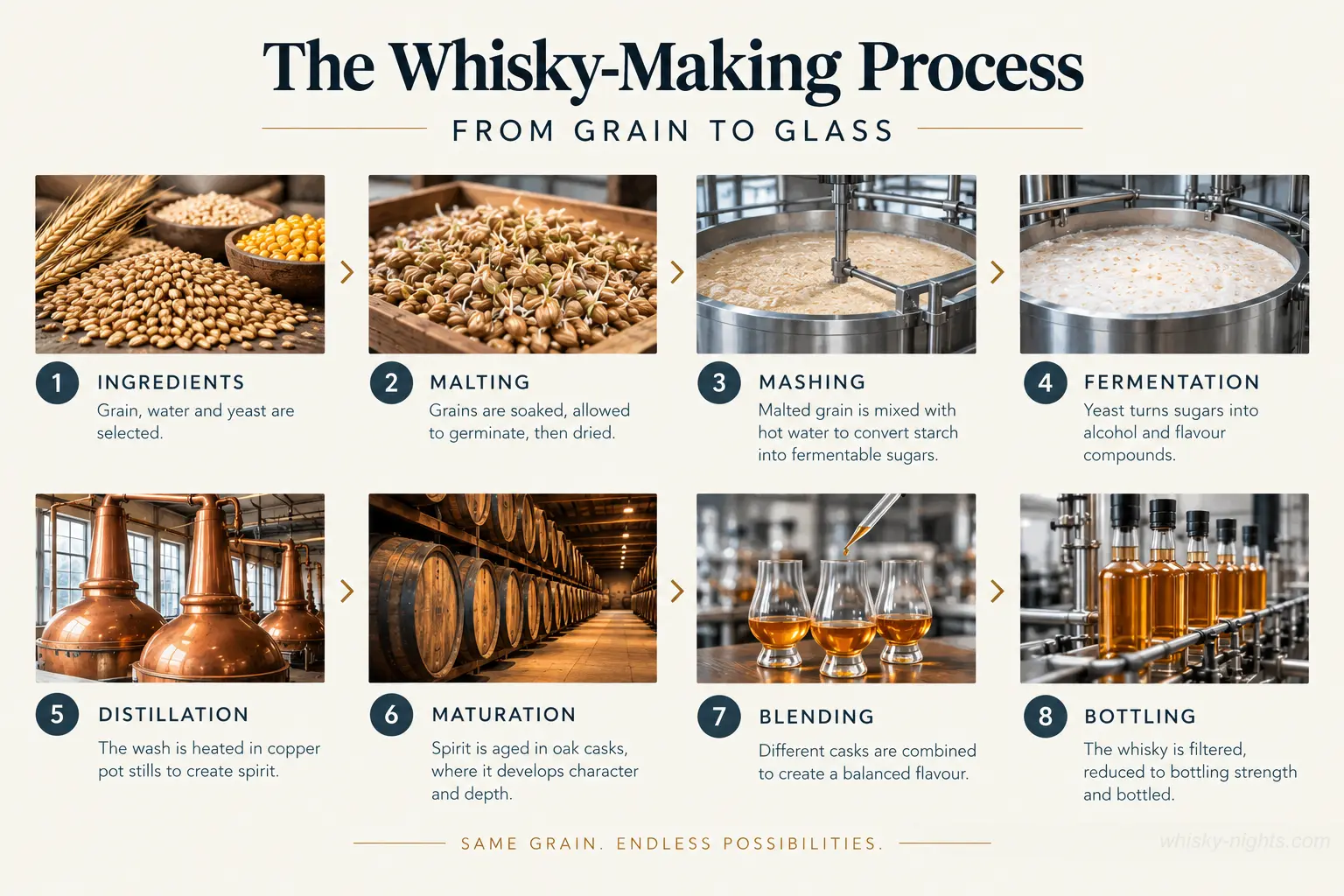
Whisky gets its character from far more than the grains used to make it. The process of converting starch into sugar, fermentation by yeast, the design and operation of the still, and the time spent maturing in casks all play a part. Together, these stages help create the wide range of flavours found in whisky, from fruity aromas and sweet grain notes to smoky character, vanilla and spice.
Scotch single malt, American bourbon and Japanese blended whisky, for example, differ in their ingredients, production methods and approaches to cask maturation. Although they all belong to the same broad category of spirit, understanding how they are made makes it easier to appreciate what distinguishes one style from another.
In this guide, we follow whisky from grain to glass, explaining each stage of production and exploring how different methods influence the final spirit. We also look at the characteristics of whisky-producing countries and the relationship between production techniques and flavour.
How Whisky Is Made: An Overview of the Production Process
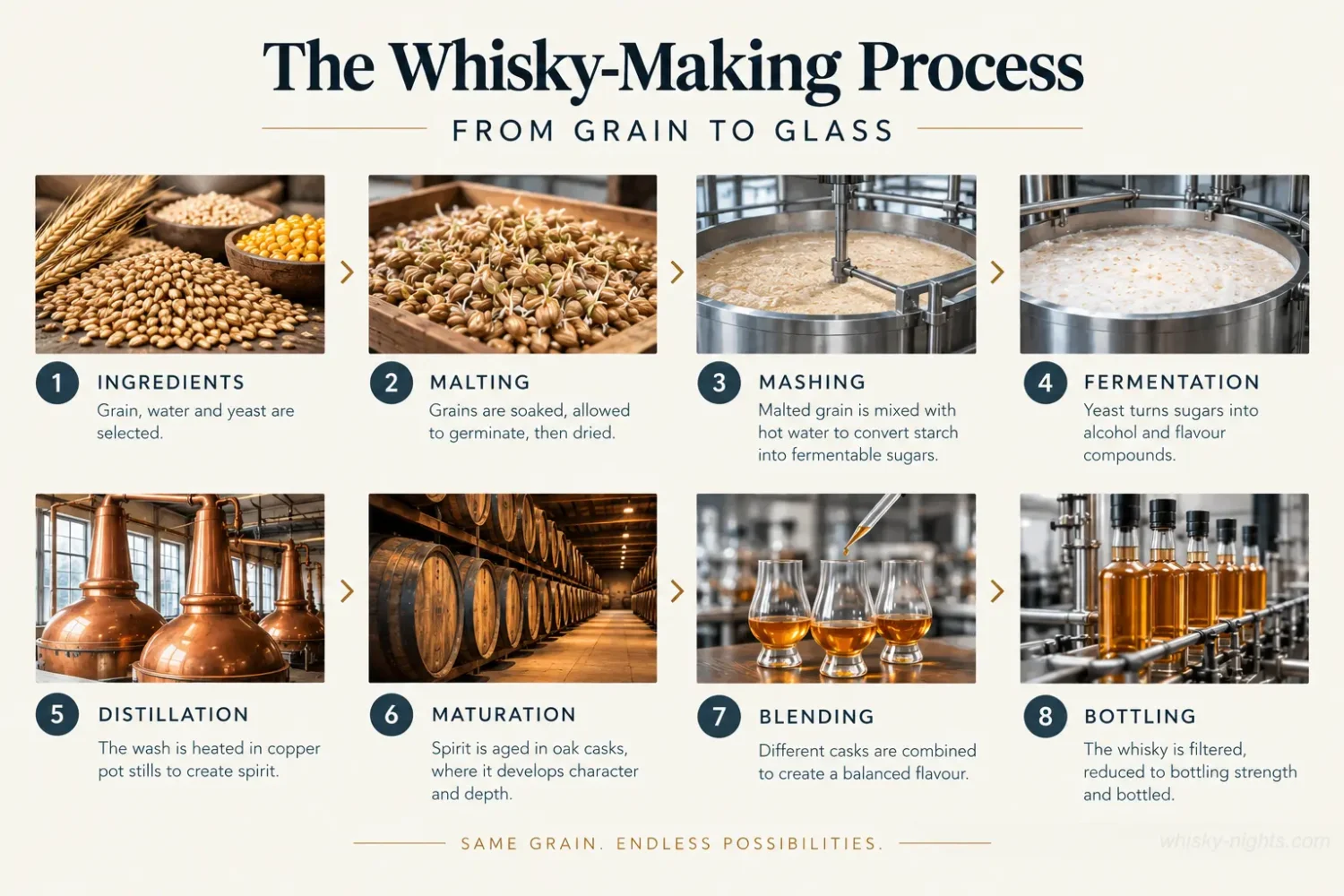
The main stages of whisky production are as follows:
- Preparing the ingredients: Grains such as barley, maize, rye and wheat are selected.
- Malting and mashing: Enzymes in malted barley help convert starch into fermentable sugars.
- Fermentation: Yeast converts sugars into alcohol and produces compounds that contribute to aroma and flavour.
- Distillation: Alcohol-containing vapour is separated from the fermented liquid, then condensed to produce a spirit.
- Maturation: The spirit develops in casks, usually made from oak, gaining colour and complexity over time.
- Blending and adjustment: Different spirits may be combined, and water may be added to achieve the desired strength.
- Bottling: The whisky may undergo filtration or other finishing processes before being bottled.
Not every whisky follows precisely the same production method. Malt whisky and grain whisky, for instance, may require different approaches to preparing the grains and distilling the spirit. Maturation periods and bottling treatments also vary according to the style of whisky being produced.
1. Whisky Ingredients: Grain, Water and Yeast
The main ingredients in whisky are grain, water and yeast. Each serves a different purpose and contributes to the character of the finished spirit.
The Main Grains Used in Whisky
| Grain | Role and characteristics |
|---|---|
| Barley | Often malted before use and forms the principal ingredient in malt whisky. Contributes cereal and malt-derived flavours |
| Maize (corn) | Used in bourbon and many grain whiskies, contributing a tendency towards sweetness and a fuller character |
| Rye | Can contribute spicy flavours and a more pronounced, lively character |
| Wheat | Often associated with a softer mouthfeel and gentler cereal flavours |
These are general tendencies rather than fixed rules. The final flavour depends not only on the grain bill but also on fermentation, distillation, maturation and other production choices.
Malt Whisky and Grain Whisky
Malt whisky is made primarily from malted barley. Scotch single malt whisky, for example, must be produced at a single distillery in Scotland using malted barley and pot still distillation, in accordance with the relevant regulations.
Grain whisky can use other cereals, including maize and wheat. Depending on the production method, these grains may be used unmalted, with malted barley added to supply enzymes for converting starch into fermentable sugars. Grain whisky is often produced using continuous stills and can provide a lighter style of spirit that plays an important role in blended whisky.
The word single does not necessarily mean that a whisky comes from one cask or one batch. Single malt whisky comes from one distillery, but it can contain spirit from many different casks. Combining casks is a normal part of producing a consistent house style.
Why Malted Barley Matters
During whisky production, the starch contained in grain must be converted into sugars that yeast can ferment. Starch cannot simply be fermented into alcohol by ordinary brewing yeast.
This is where malted barley becomes important. Malting involves allowing barley to begin germinating before drying it. During germination, enzymes, including amylase, become available to break down starch into sugars during mashing.
Consider grain whisky made primarily from maize. The maize is first cooked or otherwise processed to make its starch accessible. Malted barley can then be added to provide the enzymes needed for saccharification, the process of converting starch into fermentable sugars. The maize contributes its own characteristics to the spirit, while the malted barley helps make fermentation possible.
This distinction explains why malted barley can play an essential technical role even in whiskies whose main grain is not barley.
Water and Yeast
Water is used at several stages of whisky production, including mashing, fermentation and adjusting the spirit’s strength before bottling. Water chemistry and mineral content can influence production, although the character of a finished whisky cannot be explained by its water source alone.
Yeast is a microorganism that converts sugars into alcohol and carbon dioxide. During fermentation, it also produces aromatic compounds, including esters, which can contribute fruity notes. The yeast strain and fermentation conditions therefore play an important part in shaping a whisky’s eventual character.
2. Malting and Mashing: Converting Starch into Sugar
For malt whisky, production typically begins with malting barley. Grain whisky and other styles may require different preparation methods depending on the cereals used.
Malting
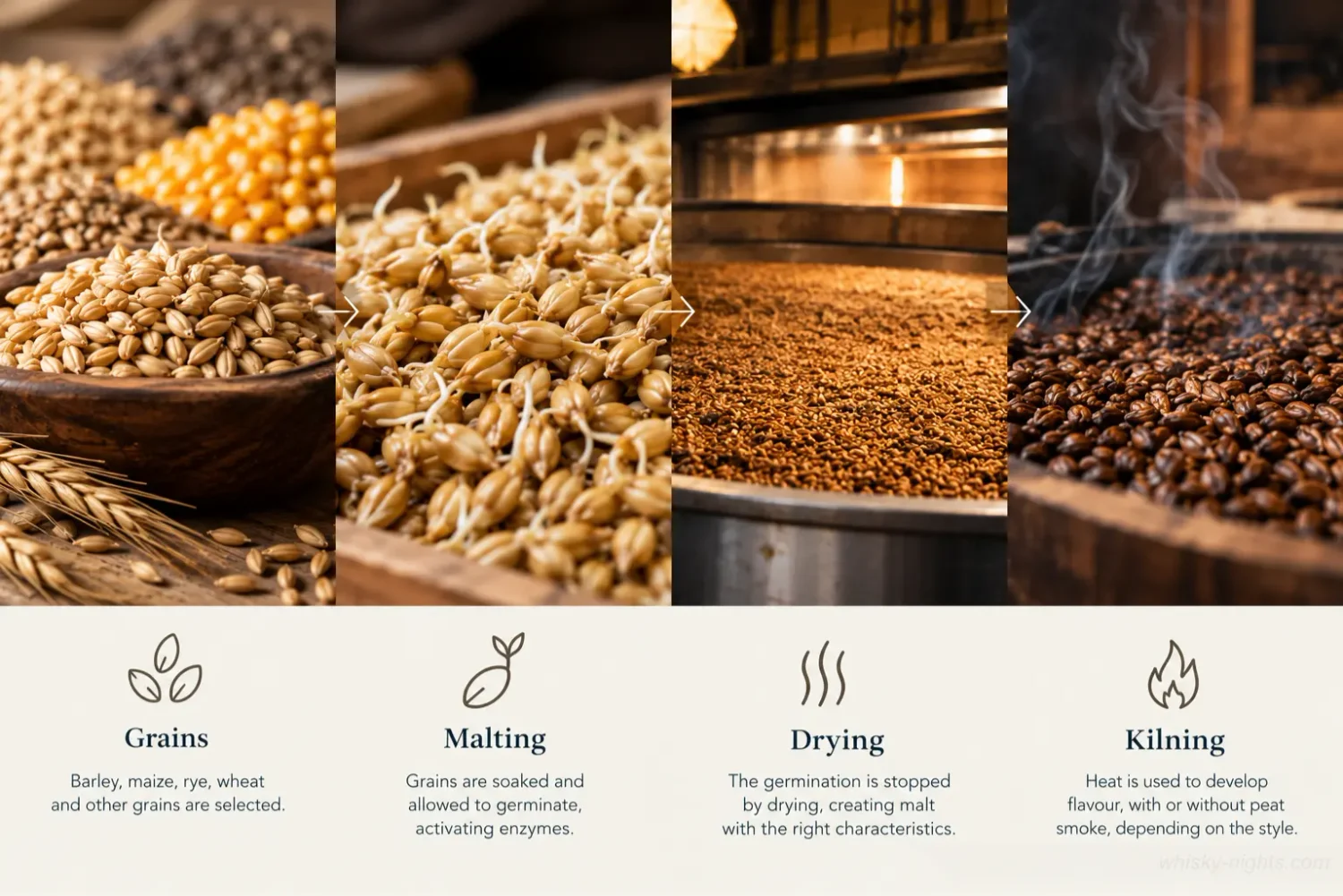
Barley is soaked in water to encourage germination. As the grain begins to grow, enzymes are produced or activated, helping make its starch accessible for the subsequent mashing process.
Germination is stopped at the appropriate stage by drying the malt. The drying method can have a significant effect on the flavour of the resulting whisky.
Some Scotch whiskies use peat, a material formed from partially decomposed vegetation, as a fuel during malt drying. The smoke deposits phenolic compounds onto the malt, which can later contribute smoky aromas reminiscent of a bonfire or smoked food. Islay, an island off Scotland’s west coast, is particularly well known for peated whisky, although not every whisky produced there is heavily smoky.
Mashing
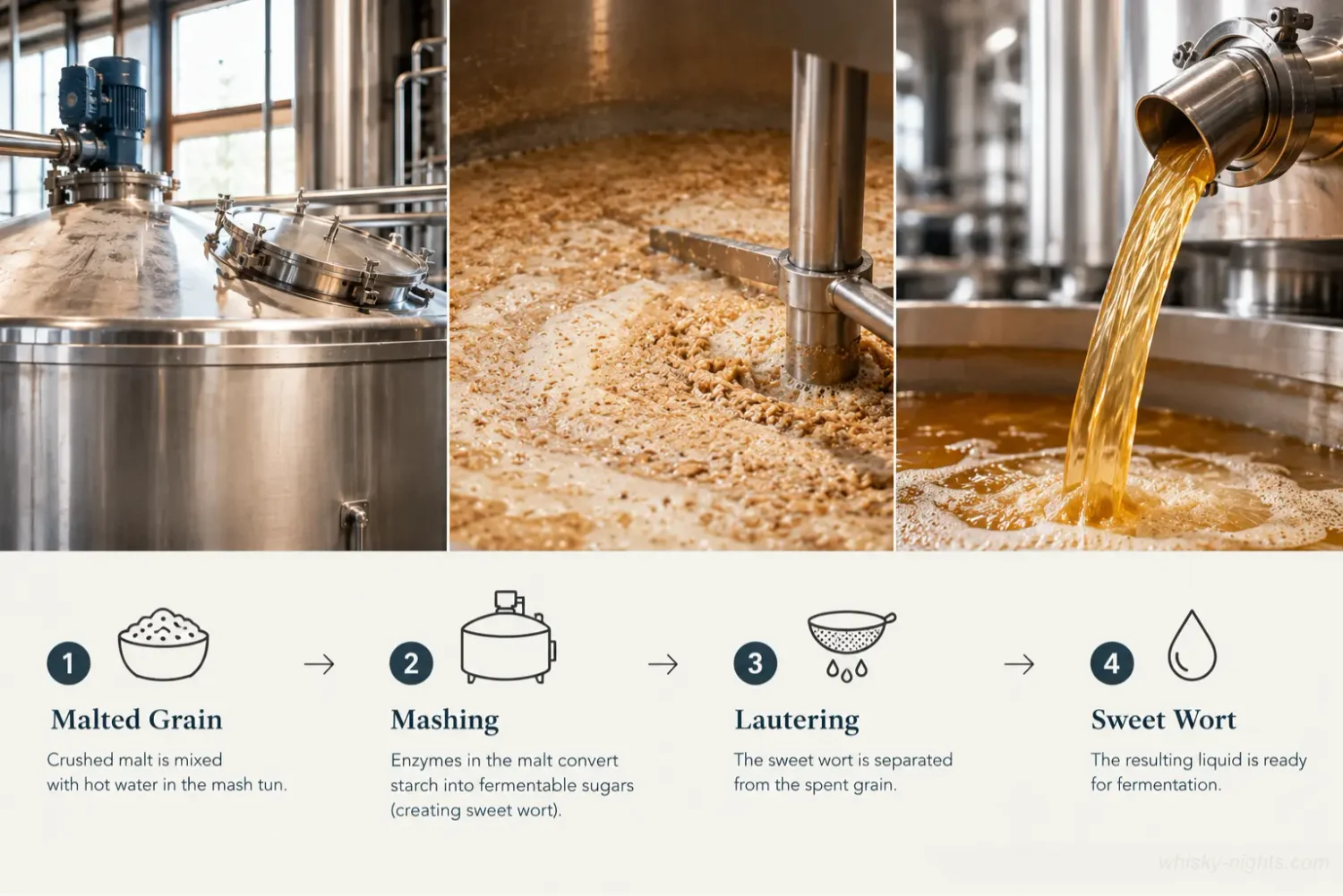
Once the malt has been dried, it is milled into a coarse material known as grist. The grist is mixed with warm water in a vessel called a mash tun. Enzymes in the malt break down starch into sugars, producing a sugary liquid known as wort.
The wort is separated from the remaining solids and transferred to a fermentation vessel.
Grain whisky production can involve additional steps. Maize and other cereals may be cooked to make their starch more accessible before enzymes from malted barley or other suitable sources are used to convert it into sugars. The precise process depends on the grain bill and the distillery’s production method.
The purpose of mashing is fundamental: it provides the fermentable sugars that yeast needs in the next stage.
3. Fermentation: Producing Alcohol and Aromatic Compounds
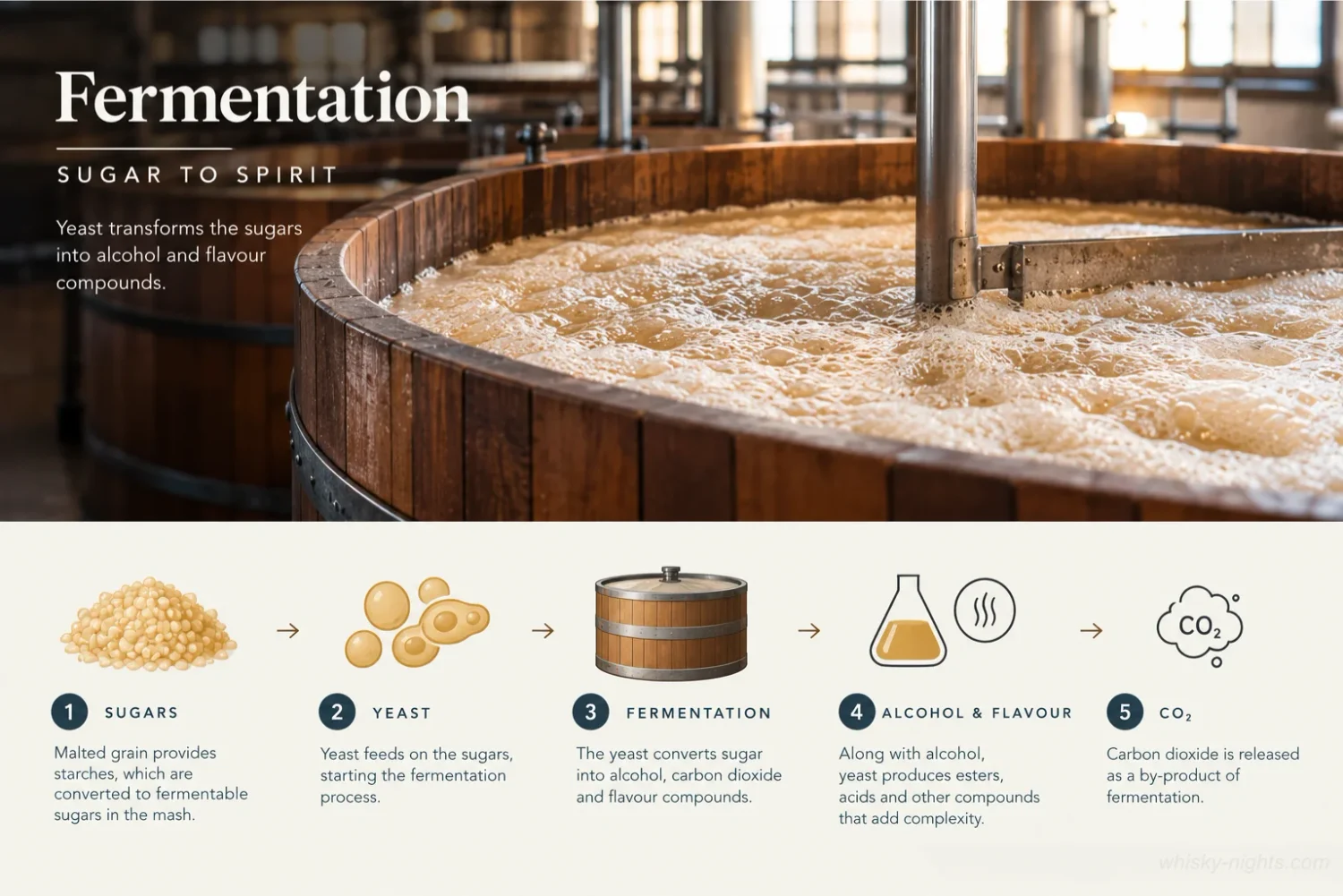
Yeast is added to the wort to begin fermentation. It consumes the available sugars, producing alcohol and carbon dioxide, along with a range of other compounds that contribute to aroma and flavour.
The fermented liquid is commonly called wash. It is a low-strength alcoholic liquid, broadly comparable to a beer before distillation, and forms the starting point for the next stage of production.
Fermentation time varies between distilleries and styles. The duration, temperature, yeast strain and other conditions affect the balance of compounds produced. Some may contribute fruity aromas, while others help create more cereal-like or complex notes.
The compounds created during fermentation do not all pass unchanged into the finished whisky. Distillation determines which components are carried forward, and cask maturation subsequently transforms the spirit further.
Fermentation is therefore more than a way of producing alcohol. It is one of the key stages at which the foundations of a whisky’s aroma and flavour are established.
4. Distillation: Shaping the Spirit’s Character
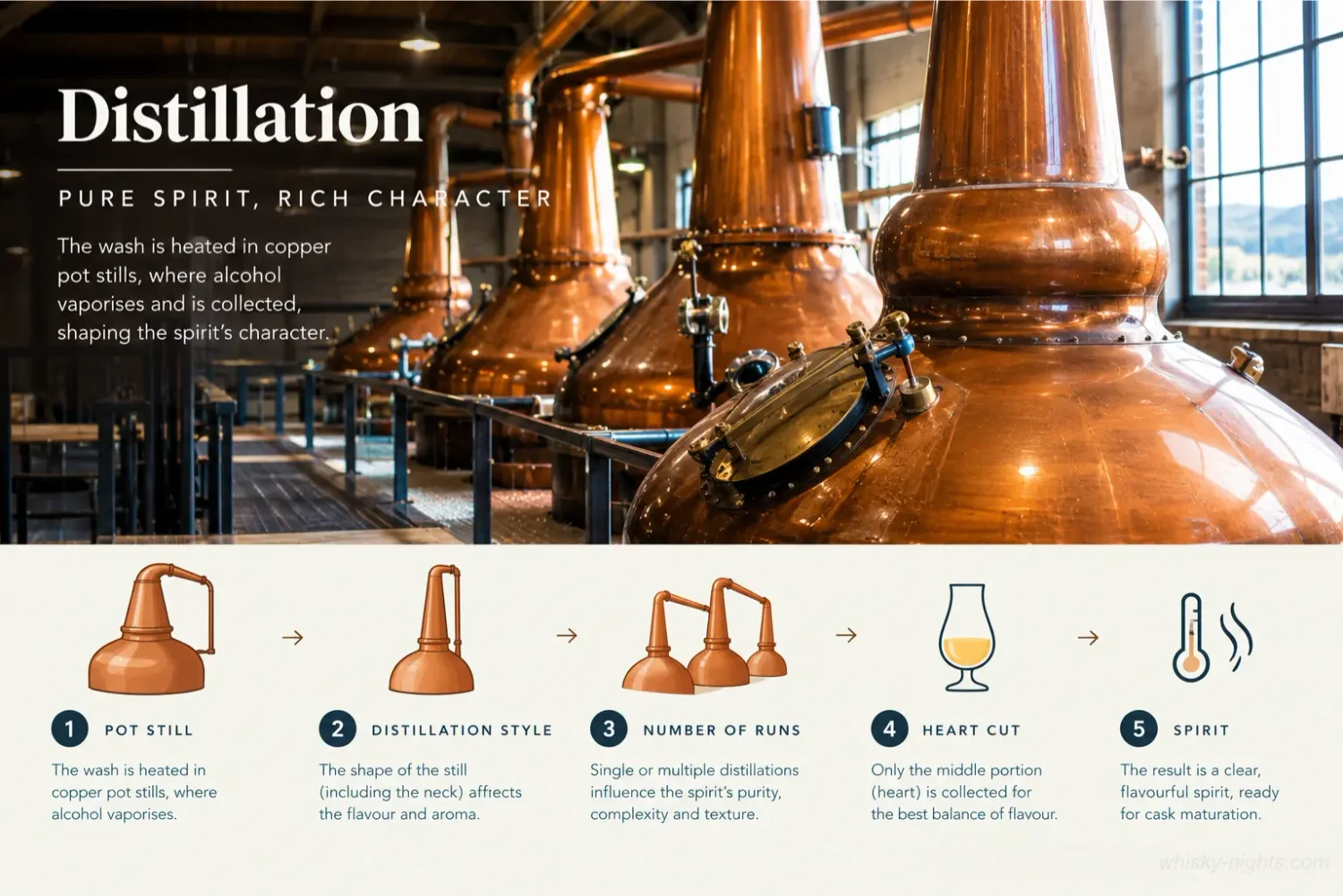
Distillation involves heating the fermented liquid so that alcohol and other volatile compounds enter the vapour. The vapour is then cooled and condensed into liquid spirit. Because alcohol and water have different volatilities, distillation can increase the alcohol concentration while also influencing the balance of aromatic compounds.
Two principal types of still are used in whisky production: pot stills and continuous stills.
| Type of still | Characteristics |
|---|---|
| Pot still | Distils a batch of liquid at a time. Commonly used for malt whisky, with the still’s design and operation influencing the character of the spirit |
| Continuous still | Processes liquid continuously. Widely used for grain whisky and capable of producing spirit efficiently at a range of strengths |
Pot stills are commonly made from copper. Contact between the spirit vapour and copper can influence the compounds that remain in the spirit. The still’s height, shape, neck, lyne arm, heating intensity and distillation speed can also affect vapour movement and reflux, helping determine the final character.
Selecting the Desired Spirit
During distillation, the distiller decides which portions of the spirit to retain. In traditional pot still distillation, the run is often discussed in terms of the heads, hearts and tails.
These terms describe different portions of the distillate, but their boundaries are not fixed. The distiller selects the portions appropriate to the desired style, taking account of changes in aroma and composition throughout the run.
The selection influences the resulting spirit. A distillery may aim for a lighter, more delicate character or a richer, more robust one, depending on how the still is operated and which portions are collected.
Freshly distilled whisky spirit is generally colourless. Much of the colour and many familiar maturation-related aromas, such as vanilla, wood and spice, develop later in the cask.
5. Maturation: How Casks Transform Whisky
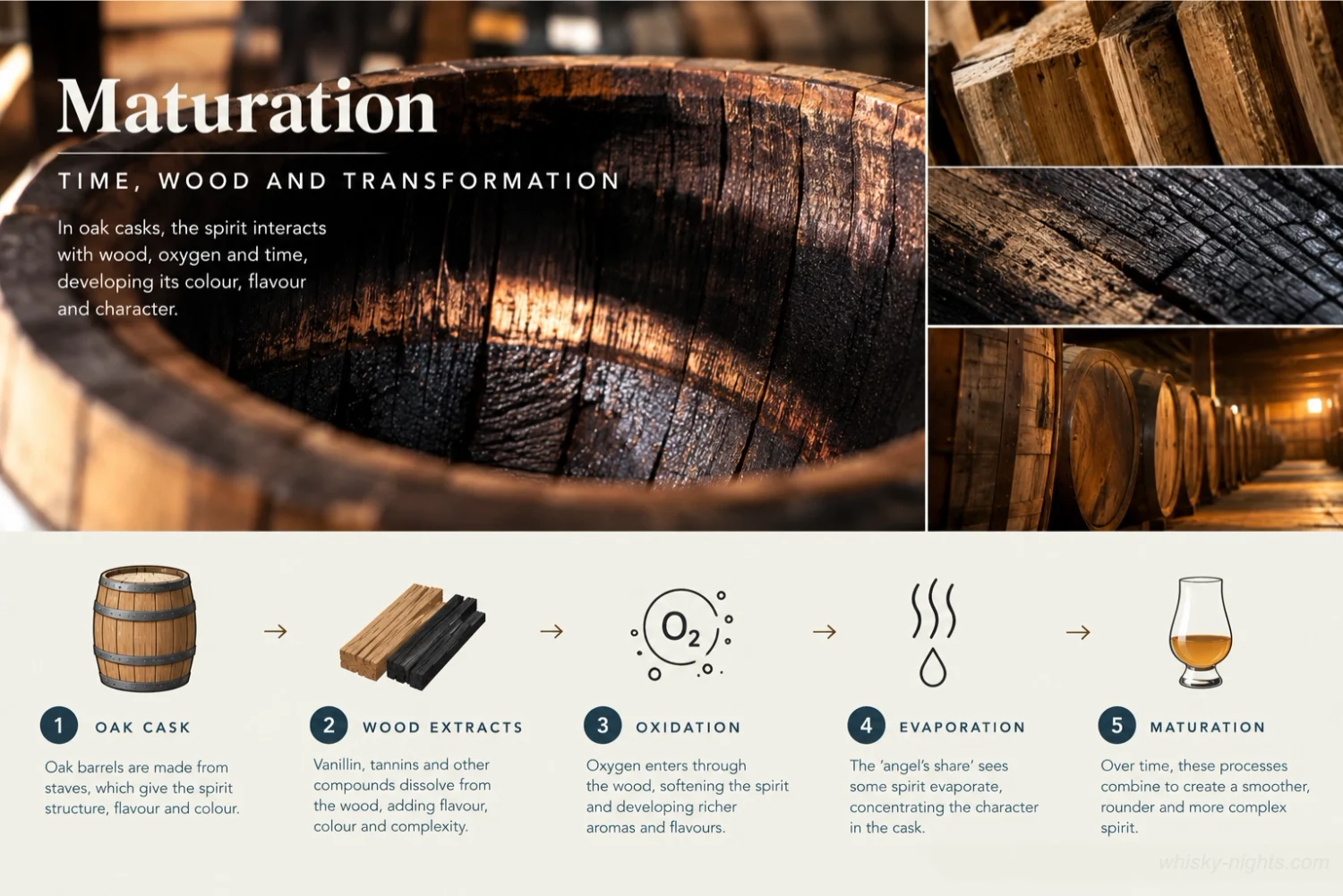
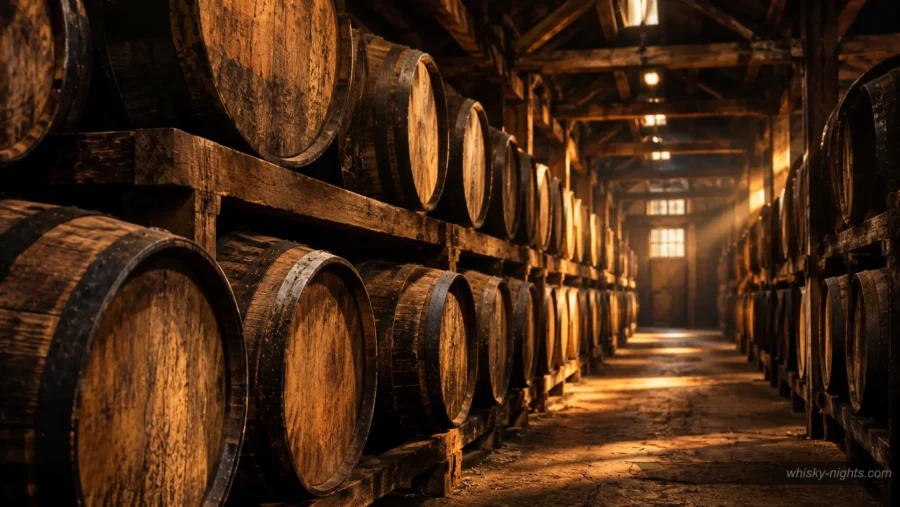
After distillation, the spirit is transferred to casks and left to mature. Oak is the principal wood used for whisky maturation. A cask is not simply a storage vessel: it plays an active role in developing the whisky’s aroma, flavour, colour and texture.
During maturation, compounds from the wood can enter the spirit. Chemical reactions take place within the liquid, while gradual interaction with oxygen also contributes to its evolution. Together, these processes help transform the new spirit into a more complex whisky.
Common Cask Types and Their Flavour Profiles
| Cask type | Typical flavour associations |
|---|---|
| Bourbon cask | Vanilla, caramel and coconut |
| Sherry cask | Dried fruit, nuts and spice |
| Port cask | Berry-like fruit notes and rich sweetness |
| Mizunara cask | Sandalwood-like aromas, spice and distinctive woody notes |
These descriptions indicate common tendencies rather than guaranteed outcomes. The effect of a cask depends on its wood, previous use, internal treatment, size, the spirit placed inside it and the conditions under which it matures.
Bourbon casks are widely used in Scotch and Japanese whisky production. Many are American oak casks that have previously held bourbon, which must be matured in new, charred oak containers under US regulations.
Sherry casks have a history associated with the maturation of sherry, although their precise construction and previous use can vary. Their influence on whisky therefore depends on more than the word sherry on a label.
Mizunara, a type of Japanese oak, has attracted particular interest in Japanese whisky production. It can be challenging to work with as a cask wood, but it is valued for the distinctive aromas it may contribute, sometimes described in terms of sandalwood, incense or spice. These characteristics are not guaranteed in every Mizunara-matured whisky; the spirit and maturation conditions remain important.
Does Older Whisky Always Taste Better?
Longer maturation can lead to greater complexity as the spirit interacts with the wood and continues to evolve. However, older whisky is not automatically better. Excessive cask influence can overwhelm the character of the original spirit, and a long maturation period may not suit every cask or style.
The ideal maturation period depends on the spirit, cask type, storage environment and intended character. The balance between the original spirit and the influence of the wood is more important than age alone.
For Scotch whisky, the regulations require maturation in oak casks in Scotland for a minimum of three years. When an age statement appears on a Scotch whisky label, it refers to the youngest whisky in the bottle. A 12-year-old blend, for example, must contain whisky that has matured for at least 12 years.
The Angel’s Share
During maturation, some of the liquid inside a cask evaporates through the wood. This gradual loss is known as the Angel’s Share.
A figure of around 2% per year is often quoted as a rough guide for Scotland, but it is not a fixed rate. Evaporation varies with temperature, humidity, cask size, storage conditions and the length of maturation.
The Angel’s Share means that the volume of whisky remaining in a cask gradually decreases. Meanwhile, the spirit continues to interact with the wood and develop in character. Both the loss of liquid and the evolution of flavour are part of the maturation process.
6. Blending and Bottling: Preparing the Finished Whisky
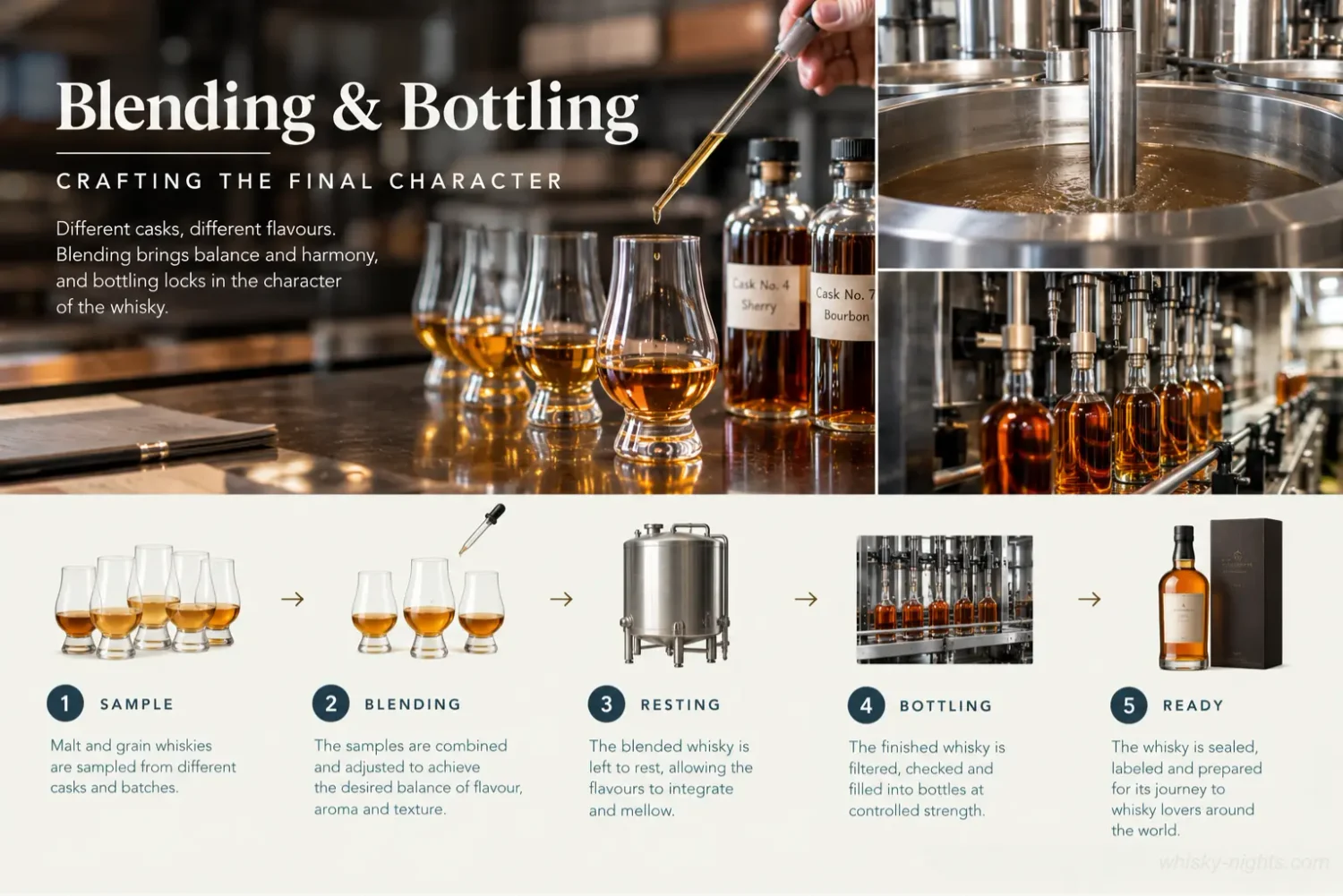
Once maturation is complete, the whisky may be combined with other casks or different types of spirit before being prepared for bottling. Depending on the product, these stages can include blending, adjusting the alcohol strength, filtration and other finishing processes.
What Is Blending?
Blending involves combining different whiskies to achieve a desired balance of aroma, flavour and consistency. Spirits from different casks, ages or production styles can complement one another, creating a profile that may be difficult to achieve with a single cask alone.
Single malt whisky comes from one distillery, but it can be blended from numerous casks. By contrast, blended whisky commonly combines malt whisky and grain whisky.
There are also blended malt whiskies, which combine malt whiskies from more than one distillery, and blended grain whiskies, which combine grain whiskies. Blending is not simply a matter of mixing spirits together: it is a skilled process used to create a particular style and maintain consistency between bottlings.
Adjusting Alcohol Strength
Before bottling, water may be added to reduce the whisky’s alcohol strength to the desired level. This can soften the sensation of alcohol and alter how aromas and flavours are perceived.
Some whiskies are bottled at a relatively high strength, closer to the strength at which they leave the cask. These may be described as cask strength. The term does not necessarily mean that the whisky comes from a single cask; a cask-strength bottling can also combine several casks.
Chill-Filtration and Non-Chill-Filtered Whisky
One treatment sometimes used before bottling is chill-filtration. When whisky is cooled, certain compounds, including some fatty acid esters, can come out of solution. This may cause the whisky to become cloudy, particularly at low temperatures or when water is added.
Chill-filtration involves cooling the whisky and filtering out some of the compounds responsible for this haze, helping the product remain clear under those conditions.
Whisky bottled without this cooling and filtration process may be described as non-chill-filtered. Such whisky can become cloudy at low temperatures or after dilution. This haze is not, by itself, a sign of a defect or poor quality.
Neither approach automatically makes a whisky better than the other. Chill-filtration is a production choice that helps maintain clarity, while non-chill-filtered bottlings avoid this particular form of treatment.
What Does Natural Colour Mean?
The term natural colour generally indicates that no colouring agents, such as plain caramel colouring, have been added. The whisky’s colour comes from its maturation and the interactions between the spirit and the cask.
Colour can vary according to the type and previous use of the cask, as well as the maturation conditions. A darker whisky is not necessarily older or better than a lighter one.
Natural colour and non-chill-filtered describe two separate characteristics. Natural colour concerns the addition of colouring agents, while non-chill-filtered refers to the absence of chill-filtration. A whisky can be natural colour and chill-filtered, or it can be non-chill-filtered while containing added colouring.
Understanding these terms makes it easier to interpret product labels and the production choices behind different bottlings.
7. Whisky Around the World: Differences in Production and Regulations

Whisky is produced in many countries, each with its own traditions, styles and, in some cases, specific legal requirements. Comparing them helps explain why whiskies made from similar ingredients can have very different characteristics.
| Whisky style | Main characteristics |
|---|---|
| Scotch whisky | Produced in Scotland. Includes malt and grain whisky, as well as a wide range of blended styles |
| Irish whiskey | Produced in Ireland. Includes malt, grain and pot still styles, with considerable variation between producers |
| Bourbon whiskey | Produced in the United States, using a mash bill containing at least 51% maize and new charred oak containers for maturation |
| Canadian whisky | Produced in Canada. Many expressions combine different spirits, with styles ranging from gentle and approachable to spicy and robust |
| Japanese whisky | Produced in Japan, with a range of approaches to blending, distillation and maturation. Industry labelling standards define requirements for products labelled as Japanese whisky |
The Legal Requirements for Bourbon
Bourbon is more than simply an American whisky made with corn. Under US regulations, bourbon must be made from a grain mixture containing at least 51% maize. It must be distilled at no more than 80% alcohol by volume (ABV) and entered into new, charred oak containers at no more than 62.5% ABV.
The requirement to use new, charred oak is especially important. The interaction between the spirit and the fresh wood contributes to the vanilla, caramel and other flavours commonly associated with bourbon.
Straight bourbon has additional requirements, including maturation for at least two years. It is therefore a distinct designation from bourbon without the straight classification.
Japanese Whisky and Its Distinctive Character
Japanese whisky developed with strong historical links to Scotch whisky, while producers have established their own approaches to distillation, blending and maturation. Both malt and grain whiskies are used, and blending plays an important role in creating a broad range of styles. The use of Mizunara oak is another feature that has attracted international attention.
There is no single flavour profile shared by all Japanese whiskies. The character of each expression depends on the distillery, the spirit produced, the casks selected, the maturation environment and the blending decisions made by the producer.
It is also important to distinguish whisky sold in Japan from whisky that meets the Japan Spirits & Liqueurs Makers Association’s labelling standards for Japanese whisky. Those standards set requirements covering matters such as the ingredients, saccharification, fermentation, distillation, maturation and bottling of products using the designation.
Understanding the distinction helps consumers interpret geographical claims and product labels more accurately.
8. How Production Methods Influence Whisky Flavour
As we have seen, no single stage determines the flavour of a whisky. The final profile develops through the combined effects of the ingredients, fermentation, distillation, maturation, blending and bottling processes.
The following table provides a broad guide to some common flavour associations.
| Flavour characteristic | Main factors that may contribute |
|---|---|
| Smoky aromas | Peat used to dry malted barley |
| Fruity aromas | Esters formed during fermentation, the selection of compounds during distillation and changes during maturation |
| Vanilla and caramel notes | Oak-derived compounds, particularly those associated with the treatment of new oak |
| Nuts and dried fruit | Cask history, the character of the spirit and maturation conditions |
| Spice and woody notes | Grain selection, distillation, cask wood and maturation |
| A lighter mouthfeel | The combined effects of ingredients, fermentation, distillation, blending and dilution |
These associations are useful starting points, not rigid rules. Fruity aromas, for example, cannot be attributed to fermentation alone: distillation affects which compounds remain in the spirit, and maturation can further change its aroma. Two whiskies matured in similar casks may still taste very different if their original spirits differ.
When tasting whisky, it can be rewarding to consider not only whether it tastes sweet, smoky or fruity, but also which stages of production may have contributed to those characteristics. The cereal notes of malt, fruit aromas associated with fermentation and vanilla or spice from cask maturation can all provide clues to the whisky’s journey from grain to glass.
Conclusion: Understanding the Process Enhances the Experience
Whisky is made by converting grain starch into sugars, fermenting those sugars, distilling the resulting liquid and maturing the spirit in casks. Yet even when whiskies follow the same basic sequence, differences in ingredients, yeast, fermentation conditions, still design, cask selection, maturation and blending can lead to strikingly different results.
The smoky character found in some Scotch whiskies, the influence of new oak in bourbon and the varied blending approaches and use of Mizunara oak in Japanese whisky all illustrate how production choices shape the finished spirit. Bottling decisions, including chill-filtration and the addition of colouring, provide further insight into how individual products are prepared.
Learning about whisky production is not about making the subject unnecessarily complicated. It is a way to understand the character of each bottle more clearly and appreciate the craft behind it. The next time you pour a dram, consider which stages of production might have contributed to its aroma, flavour and texture. You may find that knowing the journey from grain to glass makes the whisky even more rewarding to explore.
Further Reading
Here are more articles from the same category.
About Whisky Nights
Whisky Nights is a Japan-based online liquor store and whisky publication offering clear, reliable information and carefully selected bottles for international customers worldwide.
Learn more about us